


- Retrait en 2 heures
- Assortiment impressionnant
- Paiement sécurisé
- Toujours un magasin près de chez vous
- Retrait en 2 heures
- Assortiment impressionnant
- Paiement sécurisé
- Toujours un magasin près de chez vous



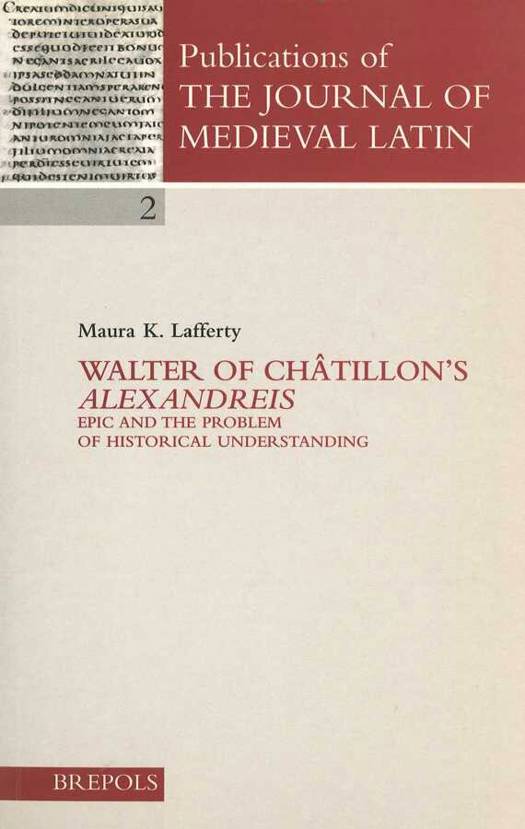
Walter of Châtillon's 'Alexandreis'. Epic and the Problem of Historical Understanding
M.K. Lafferty
53,00 €
+ 106 points
Description
Walter of Chatillon, the twelfth-century Latin poet now famed for his satirical lyrics, acquired international renown in the Middle Ages for his epic on Alexander the Great, the Alexandreis. This work did for the Middle Ages what Vergil had done for the Romans, proving the ability of the moderni to rival the ancients in learning and the arts. The Alexandreis immediately joined the Aeneid in the medieval paideia and was read in schoolrooms throughout Europe in the thirteenth and fourteenth centuries. The Alexandreis enters into the twelfth-century debate about education. The intellectual world was rapidly changing, as the schools became specialized and professionalized, threatening the hitherto secure position of the liberal arts and Latin literature in the educational curriculum. At the same time, translations from Arabic and Greek, not only of the works of Aristotle, but also of Arabic philosophers, had begun to alter the concerns and methodologies of Western scholars. Theologians increasingly used Hebrew commentaries in their studies of the Hebrew Scriptures. The awareness of the intellectual achievements both of the ancients and of highly-civilized non-Christian contemporary cultures had reached a new peak. Twelfth-century intellectuals were presented with the challenge of assimilating the flow of new works and ideas into western historiography and the Latin world-view. Walter's exploration of the problems of interpretating not only languages, but also the texts, philosophies, religions and literatures of the past, is the subject of this study.
Spécifications
Parties prenantes
- Auteur(s) :
- Editeur:
Contenu
- Nombre de pages :
- 240
- Langue:
- Français
- Collection :
- Tome:
- n° 2
Caractéristiques
- EAN:
- 9782503505763
- Date de parution :
- 30-04-98
- Format:
- Livre broché
- Format numérique:
- Trade paperback (VS)
- Dimensions :
- 165 mm x 251 mm
- Poids :
- 450 g


Seulement chez Librairie Club
+ 106 points sur votre carte client de Librairie Club
Cadeau


Les avis
Nous publions uniquement les avis qui respectent les conditions requises. Consultez nos conditions pour les avis.