


- Retrait en 2 heures
- Assortiment impressionnant
- Paiement sécurisé
- Toujours un magasin près de chez vous
- Retrait gratuit dans votre magasin Club
- 7.000.0000 titres dans notre catalogue
- Payer en toute sécurité
- Toujours un magasin près de chez vous



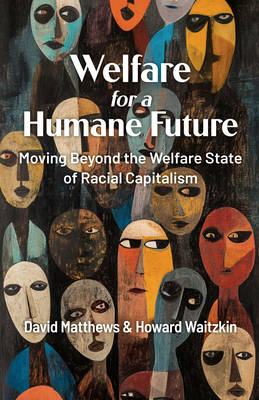
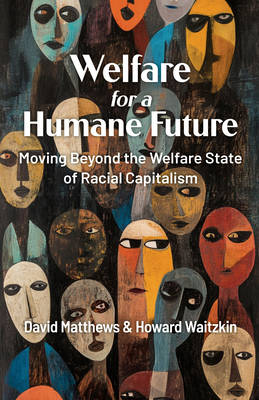
Welfare for a Humane Future: Moving Beyond the Welfare State of Racial Capitalism
Moving Beyond the Welfare State of Racial Capitalism
David Matthews
Livre broché | Anglais
25,45 €
+ 50 points
Description
Welfare for people in need always contains profound contradictions. Under capitalism, the welfare state reinforces exploitation and discrimination, yet working people have fought for welfare, which protects against the worst excesses of capitalism. Given the important benefits that welfare can provide, we need to consider the components of a post-capitalist welfare system, one that actually meets the needs of working people. A post-capitalist welfare system puts into practice the values of love, care, solidarity, and cooperation. Such principles are incompatible with the values of racial capitalism. So we work for a post-capitalist alternative. We trace the emphasis on love as a source of revolutionary motivation to key works by Karl Marx, Che Guevara, leaders of Back Lives Matter, and others trying to move beyond racial capitalism. A transformed welfare system depends on communities whose collective values nurture care and wellbeing. Communal institutions that provide welfare services are key. We analyze the eventual failures of historical utopian communities and also some strengths and limitations of communal institutions that have implemented welfare systems in "actually existing" socialist countries. A transformation of values depends on a bottom-up aspiration, not imposed by a state apparatus. We examine three examples of communal governance linked to development of post-capitalist welfare systems: the Rojava revolution in northern Syria, the Bolivarian revolutionary process in Venezuela, and Cooperation Jackson in Mississippi. These examples provide illuminating details about the contrasting theoretical underpinnings, practical implementation of community-based institutions and governance, strengths and limitations of these approaches, and concrete details of welfare systems that move beyond racial capitalism and the capitalist welfare state. These examples all include the creation of "solidarity economies" linked to community-based welfare systems that foster mutual aid and reject the inherently exploitative characteristics of racial capitalism. Local assemblies become the most direct means of confronting the capitalist state, usually at the level of the municipality. A transitional platform for post-capitalist welfare includes four key components: democratic control over public funds, community-based cooperatives and mutual aid, expanded access to housing, and promotion of community wellbeing. Within our communities today, existing institutions and organizations provide spaces relatively free from capitalist values. Institutions and organizations that emphasize justice and resistance often provide mutual aid that forms the basis of a post-capitalist welfare system. We explain what mutual aid actually entails, demonstrating the fundamental concepts and goals associated with it and what type of mutual aid these institutions and organizations can implement. Focusing on housing, health, and income maintenance, we analyze important examples of mutual aid and cooperative organizations that now provide these services. Such organizations allow those who use and support the services to exert influence over their management. Improved access to housing in Cooperation Jackson and similar efforts involving community land trusts, as well as cooperative housing schemes in Britain, show achievements fostered in post-capitalist systems. Community-based health initiatives in multiple countries and social contexts show the feasibility and advantages of providing such services outside public or private insurance programs. A post-capitalist welfare system is community-based and controlled by the community rather than the state. Communities establish welfare institutions based on mutual aid and cooperatives to help build a society rooted in love, care, solidarity, and dignity. As the creators of Cooperation Jackson advise, now is the time for "building the future in the present."
Spécifications
Parties prenantes
- Auteur(s) :
- Editeur:
Contenu
- Nombre de pages :
- 74
- Langue:
- Anglais
Caractéristiques
- EAN:
- 9781998309528
- Date de parution :
- 01-04-25
- Format:
- Livre broché
- Format numérique:
- Trade paperback (VS)
- Dimensions :
- 140 mm x 216 mm
- Poids :
- 95 g


Seulement chez Librairie Club
+ 50 points sur votre carte client de Librairie Club
Cadeau

Cadeau


Les avis
Nous publions uniquement les avis qui respectent les conditions requises. Consultez nos conditions pour les avis.