


- Retrait en 2 heures
- Assortiment impressionnant
- Paiement sécurisé
- Toujours un magasin près de chez vous
- Retrait en 2 heures
- Assortiment impressionnant
- Paiement sécurisé
- Toujours un magasin près de chez vous



35,45 €
+ 70 points
Description
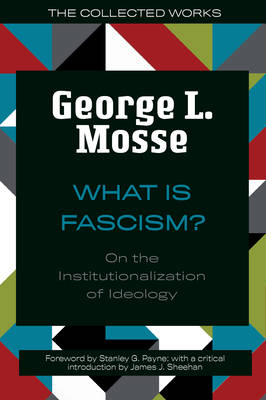
In 1963, nearly two decades after the end of the most destructive war in human history, George L. Mosse assembled a group of interdisciplinary scholars from diverse backgrounds to answer a seemingly simple question: What is fascism? The landmark seminar that followed, held at Stanford University, came to define the intellectual conversation about European fascism throughout the postwar era. Mosse strove to better understand the legacy of fascism by debating its origins--often contentiously--with the sharpest minds of his generation.
In this volume, which collects Mosse's lectures as well as his peers' responses, Mosse and his colleagues wrestle with fascism's origins and impact. The straightforward question that launched the seminar quickly expands to deeper debates: What are the intellectual foundations of right-wing populist political movements? How had these particular movements risen to power so quickly and then left so much devastation in their wakes? Were charismatic leaders like Hitler and Mussolini driving forces or did the various incarnations of fascism throughout Europe and beyond constitute a broader "revolution"? What was the relationship of religious and cultural institutions to fascism's rise and cataclysmic fall?
As the word "fascism" takes on new meaning in the twenty-first century, it is more urgent than ever to revisit the work of scholars who witnessed its birth--and its defeat. In the foreword, Stanley G. Payne situates the lively debate in its historical context, and in the critical introduction, James J. Sheehan shares his own memories of the seminar and reflects on how the experience drove Mosse's later work.
Spécifications
Parties prenantes
- Auteur(s) :
- Editeur:
Contenu
- Nombre de pages :
- 326
- Langue:
- Anglais
- Collection :
Caractéristiques
- EAN:
- 9780299358341
- Date de parution :
- 14-07-26
- Format:
- Livre broché
- Format numérique:
- Trade paperback (VS)
- Dimensions :
- 152 mm x 229 mm
- Poids :
- 453 g


Seulement chez Librairie Club
+ 70 points sur votre carte client de Librairie Club
Cadeau


Les avis
Nous publions uniquement les avis qui respectent les conditions requises. Consultez nos conditions pour les avis.