


- Retrait en 2 heures
- Assortiment impressionnant
- Paiement sécurisé
- Toujours un magasin près de chez vous
- Retrait en 2 heures
- Assortiment impressionnant
- Paiement sécurisé
- Toujours un magasin près de chez vous



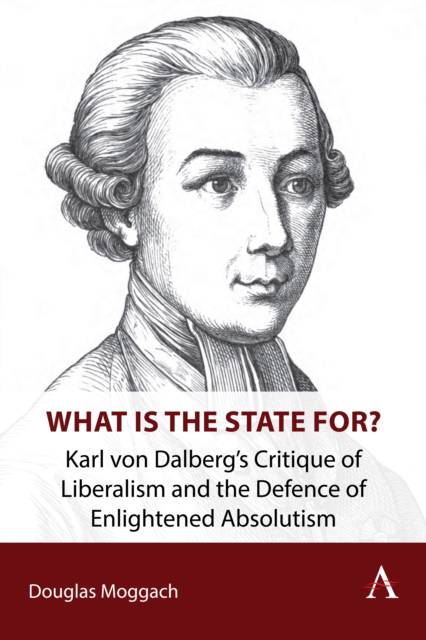
What Is the State For?
Karl Von Dalberg's Critique of Liberalism and the Defence of Enlightened Absolutism
Douglas Moggach
28,45 €
+ 56 points
Description
Karl von Dalberg (1744-1817) was the scion of a prominent aristocratic family in the Holy Roman Empire. He served as the Empire's last Reichskanzler (1802-1806) before its dissolution by Napoleon, and subsequently as Prince-Primate of the Confederation of the Rhine (1806-1813), implementing Napoleonic reforms in the Rhineland. In the 1790s, he had been active as a political theorist and a member of Friedrich Schiller's intellectual circle in Jena. Dalberg's early text of 1793, 'Von den wahren Grenzen der Wirksamkeit des Staats' ['The True Limits of the Effectiveness of the State'], published anonymously but securely attributed, defends Christian Wolff's perfectionist theory of the state against Kantian critiques, especially as these were formulated in 1792 by Wilhelm von Humboldt (1767-1835). The confrontation between Dalberg and Humboldt illustrates the early reception of Kant's moral, political and juridical thought, and varying German responses to the French Revolution. Dalberg offers an insightful defence of the older perfectionism, while distinguishing it from new liberal and republican approaches.
Dalberg himself had encouraged Humboldt to publish his largely Kantian reflections on the role of the state. Humboldt's text, Ideen zu einem Versuch, die Grenzen der Wirksamkeit des Staats zu bestimmen [An Attempt to Determine the Limits of the Effectiveness of the State], was published in part in 1792, truncated by Prussian censorship, and the complete work appeared posthumously only in 1851. Humboldt advocated a minimalist state, which he took to be consistent with Kant's repudiation of Wolffian perfectionism in the Groundwork of the Metaphysics of Morals (1785) as inimical to the self-determination of persons. The state was to be the agent of freedom and not of happiness. Dalberg responded with a critique of the minimalist state. He defended Wolffian enlightened absolutism, bolstering Wolff's position with anthropological arguments about indolence and co-ordination to support the view that without broad state intervention and guidance, society stagnates, and perfection, or happiness, becomes unattainable. Dalberg's response retains a strongly reformist orientation, differentiating him from other contemporary offshoots of Wolffianism, such as the staunchly conservative Historical School of Law. Dalberg is thus a representative of Enlightened absolutism in the context of the French Revolution, and his subsequent political career exemplifies this position.
Spécifications
Parties prenantes
- Auteur(s) :
- Editeur:
Contenu
- Nombre de pages :
- 100
- Langue:
- Anglais
- Collection :
- Tome:
- n° 1
Caractéristiques
- EAN:
- 9781839993879
- Date de parution :
- 09-03-27
- Format:
- Livre broché
- Format numérique:
- Trade paperback (VS)
- Dimensions :
- 152 mm x 229 mm
- Poids :
- 453 g



Seulement chez Librairie Club
+ 56 points sur votre carte client de Librairie Club
Cadeau


Les avis
Nous publions uniquement les avis qui respectent les conditions requises. Consultez nos conditions pour les avis.