


- Retrait en 2 heures
- Assortiment impressionnant
- Paiement sécurisé
- Toujours un magasin près de chez vous
- Retrait en 2 heures
- Assortiment impressionnant
- Paiement sécurisé
- Toujours un magasin près de chez vous



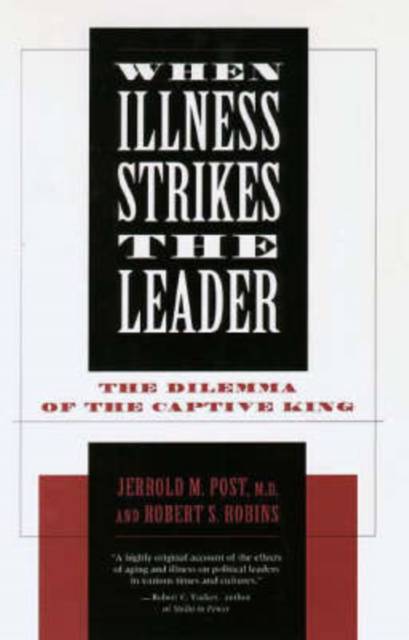
When Illness Strikes the Leader
The Dilemma of the Captive King
Jerrold M Post
Livre broché | Anglais
64,45 €
+ 128 points
Description
The illness or disability of a world leader can change the course of history. When Lenin became too infirm to remove Stalin from a position of power, when the shah of Iran's terminal cancer was kept secret from fellow Iranians and foreign supporters until Ayatollah Khomeini's Islamic revolution had succeeded, the political consequences were monumental. In this absorbing book, two experts in political psychology reveal how the infirmities of leaders have affected their own societies and the broader course of world events. Drawing on a wide range of examples, including Mad King Ludwig of Bavaria, Woodrow Wilson, Adolf Hitler, Idi Amin, Deng Xiao-peng, Ferdinand Marcos, Franklin Delano Roosevelt, and Menachem Begin, Dr. Jerrold M. Post and Robert S. Robins explore the impact of physical and mental illness on political leadership. Post and Robins investigate the effects of illness on the leader, his inner circle, his followers, and the political system itself. They discuss such thought-provoking topics as: -how the nature of the illness affects decisionmaking; -how mortal illness can make a leader more determined to make his mark on history; -how a leader's disability can be hidden from the public in every political system; -the effects of prescribed drugs and substance abuse on leadership behavior; -the conflicted role and ethical dilemmas of physicians who care for the powerful; -and how the demands and privileges of high office compromise the quality of medical care. In closed societies where there is no clear mechanism of succession, say the authors, the ailing or aging leader and his close advisers can become locked in a fatal embrace, each dependent upon the other for survival: a captive king and his captive court. In the absence of clear rules for determining when a leader is disabled and should be replaced and how a successor will be chosen, illness in high office can be highly destabilizing. Post and Robins's book will be engrossing-and timely-reading for all those interested in leadership, history, and the political process.
Spécifications
Parties prenantes
- Auteur(s) :
- Editeur:
Contenu
- Nombre de pages :
- 262
- Langue:
- Anglais
Caractéristiques
- EAN:
- 9780300063141
- Date de parution :
- 01-02-95
- Format:
- Livre broché
- Format numérique:
- Trade paperback (VS)
- Dimensions :
- 152 mm x 234 mm
- Poids :
- 385 g


Seulement chez Librairie Club
+ 128 points sur votre carte client de Librairie Club
Cadeau


Les avis
Nous publions uniquement les avis qui respectent les conditions requises. Consultez nos conditions pour les avis.