


- Retrait en 2 heures
- Assortiment impressionnant
- Paiement sécurisé
- Toujours un magasin près de chez vous
- Retrait en 2 heures
- Assortiment impressionnant
- Paiement sécurisé
- Toujours un magasin près de chez vous



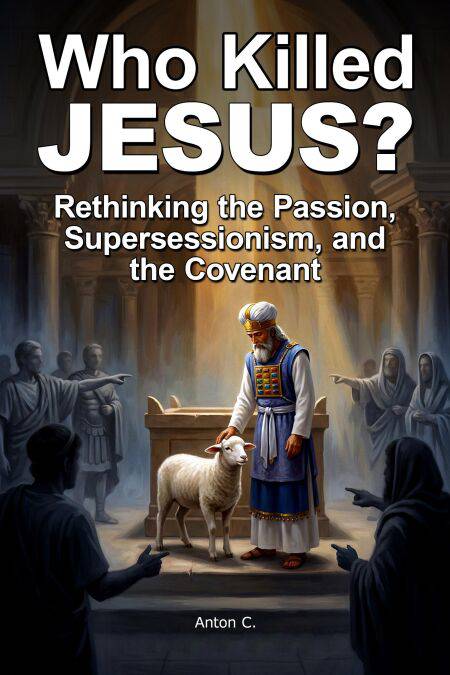
Who Killed Jesus - Rethinking the Passion, Supersessionism, and the Covenant EBOOK
Replacement Theology, #2
Anton C.
3,49 €
+ 3 points
Description
Who Killed Jesus? The Question Christianity Has Been Answering Wrong for Two Thousand Years.
For nearly twenty centuries, supersessionism (replacement theology) has pointed its finger at the Jewish people and called them "Jesus killers." It built ghettos with that accusation. It lit fires with it. It provided the theological atmosphere in which the worst genocide in Western history became imaginable. And it was wrong, not politically wrong, not diplomatically wrong, but scripturally, typologically, and covenantally wrong, in ways that a careful reading of Leviticus, Exodus, John, Hebrews, and 1 Corinthians makes impossible to miss.
This book corrects the record.
The answer to "Who killed Jesus?" is not the Jewish people. The answer, given plainly by the Levitical law that governed every sacrifice ever offered in Israel, is the High Priest. Only the High Priest could kill the Passover lamb. Only the High Priest could carry the blood into the Holy of Holies on the Day of Atonement. Only the High Priest could press both hands on the scapegoat and confess the nation's sins over it. No Gentile held this authority. Not a Roman soldier. Not Pontius Pilate. Not Caesar himself. Without the priesthood of Israel performing its appointed function, there was no valid sacrifice. And without the sacrifice, there was no atonement, no Christianity, and no Church.
Caiaphas, the High Priest, did not commit murder at Calvary. He performed his office. When he declared it expedient for one man to die for the people, the Apostle John records explicitly that he "prophesied" this, speaking by virtue of his priestly office, not merely from political calculation. When the crowd cried "His blood be on us and on our children," they were not calling down a curse. In the language of Leviticus and Exodus, blood placed on the people was the covenantal blessing of the sacrifice received. Moses sprinkled the covenant blood on the people at Sinai. The High Priest sprinkled the atoning blood before the mercy seat. Blood on the people was the sign of grace extended, not guilt assigned.
The Passover lamb was inspected for four days before it was slain. Jesus rode into Jerusalem on Nisan 10 and was examined by the religious authorities for four days before His death on Nisan 14, exactly as Exodus 12 required. Pilate's three declarations of innocence, "I find no fault in him," were not failed attempts to save an innocent man. They were the Gentile world's unwilling participation in the Levitical inspection, confirming what the Law demanded: the sacrifice is without blemish. Even this Gentile governor, with all the power of Rome behind him, could not perform the sacrifice. He could only certify the Lamb's fitness and step aside.
The sacrifice was not a crime that happened to fulfill prophecy. It was a fulfillment of prophecy that required a crime's instruments without making those instruments its primary authors. God ordained the plan before the foundation of the world.
This book is a systematic, Scripture-grounded, typologically rigorous, and pastorally urgent argument that the Jewish people were not the killers of Jesus. They were His sacrificers, appointed by a covenantal system that God Himself designed, operating within a mystery that God Himself hid, fulfilling a script that God Himself wrote before the world was made.
The Lamb was always meant to be slain. The High Priest was always meant to slay Him. To blame the priest for the sacrifice is not theology. It is a category error with a two-thousand-year body count.
It is time the Church read the script correctly and understand the interpretation - who killed Jesus.
Spécifications
Parties prenantes
- Auteur(s) :
- Editeur:
Contenu
- Langue:
- Anglais
- Collection :
Caractéristiques
- EAN:
- 9798201350086
- Date de parution :
- 02-04-26
- Format:
- Ebook
- Protection digitale:
- /
- Format numérique:
- ePub


Seulement chez Librairie Club
+ 3 points sur votre carte client de Librairie Club
Cadeau


Les avis
Nous publions uniquement les avis qui respectent les conditions requises. Consultez nos conditions pour les avis.