


- Retrait en 2 heures
- Assortiment impressionnant
- Paiement sécurisé
- Toujours un magasin près de chez vous
- Retrait gratuit dans votre magasin Club
- 7.000.0000 titres dans notre catalogue
- Payer en toute sécurité
- Toujours un magasin près de chez vous



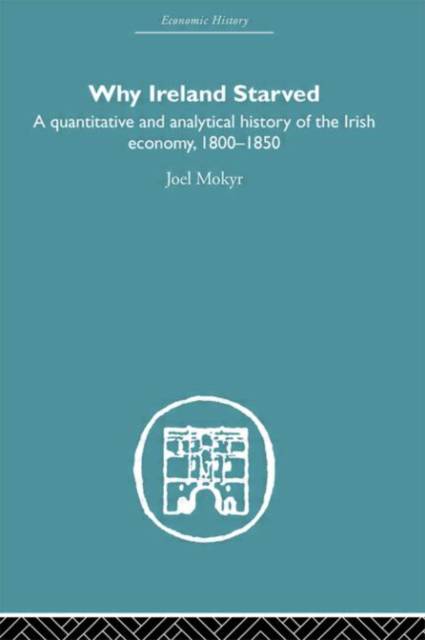
Why Ireland Starved
A Quantitative and Analytical History of the Irish Economy, 1800-1850
Joel Mokyr
404,45 €
+ 808 points
Format
Description
Technical changes in the first half of the nineteenth century led to unprecedented economic growth and capital formation throughout Western Europe; and yet Ireland hardly participated in this process at all. While the Northern Atlantic Economy prospered, the Great Irish Famine of 1845-50 killed a million and a half people and caused hundreds of thousands to flee the country. Why the Irish economy failed to grow, and 'why Ireland starved' remains an unresolved riddle of economic history.
Professor Mokyr maintains that the 'Hungry Forties' were caused by the overall underdevelopment of the economy during the decades which preceded the famine. In Why Ireland Starved he tests various hypotheses that have been put forward to account for this backwardness. He dismisses widespread arguments that Irish poverty can be explained in terms of over-population, an evil land system or malicious exploitation by the British. Instead, he argues that the causes have to be sought in the low productivity of labor and the insufficient formation of physical capital - results of the peculiar political and social structure of Ireland, continuous conflicts between landlords and tenants, and the rigidity of Irish economic institutions.
Mokyr's methodology is rigorous and quantitative, in the tradition of the New Economic History. It sets out to test hypotheses about the causal connections between economic and non-economic phenomena. Irish history is often heavily coloured by political convictions: of Dutch-Jewish origin, trained in Israel and working in the United States. Mokyr brings to this controversial field not only wide research experience but also impartiality and scientific objectivity.
The book is primarily aimed at numerate economic historians, historical demographers, economists specializing in agricultural economics and economic development and specialists in Irish and British nineteenth-century history. The text is, nonetheless, free of technical jargon, with the more complex material relegated to appendixes. Mokyr's line of reasoning is transparent and has been easily accessible and useful to readers without graduate training in economic theory and econometrics since ists first publication in 1983.
Spécifications
Parties prenantes
- Auteur(s) :
- Editeur:
Contenu
- Nombre de pages :
- 344
- Langue:
- Anglais
- Collection :
Caractéristiques
- EAN:
- 9780415380546
- Date de parution :
- 03-11-05
- Format:
- Livre relié
- Format numérique:
- Genaaid
- Dimensions :
- 162 mm x 240 mm
- Poids :
- 644 g


Seulement chez Librairie Club
+ 808 points sur votre carte client de Librairie Club
Cadeau

Cadeau


Les avis
Nous publions uniquement les avis qui respectent les conditions requises. Consultez nos conditions pour les avis.