


- Retrait en 2 heures
- Assortiment impressionnant
- Paiement sécurisé
- Toujours un magasin près de chez vous
- Retrait gratuit dans votre magasin Club
- 7.000.0000 titres dans notre catalogue
- Payer en toute sécurité
- Toujours un magasin près de chez vous



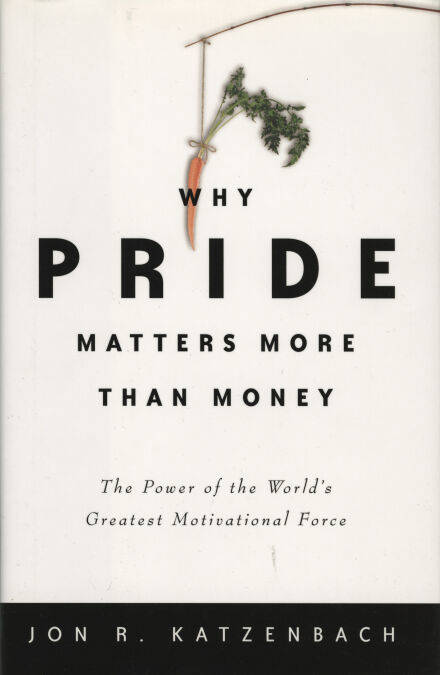
Why Pride Matters More Than Money EBOOK
The Power of the World's Greatest Motivational Force
Jon R. Katzenbach
Ebook | Anglais
6,90 €
+ 6 points
Description
The book that turns our understanding of motivation on its head . . . and shows why most companies get it wrong.
There are few people with more experience and accumulated wisdom about the inner workings of business and how people can work together more effectively than Jon Katzenbach. His groundbreaking research has resulted in several important books, including The Wisdom of Teams and Real Change Leaders. Over the past several years he has turned his attention to one of the perennial questions of leaders everywhere: How do I motivate my employees?
Most everyone frets about how to devise schemes that will keep the troops revved up. Conventional wisdom—or at least the practice at most companies—often centers on money as the primary motivating force. Many also rely on intimidation, which like money generally has a short-term impact. But what Katzenbach has found in his research at many organizations is that both of these practices do little to build the long-term sustainability of an organization. For that you need a powerful force that has been—until this point—understood by few managers and implemented by fewer still: pride.
From the front lines to the executive suite, most people are motivated by feelings of accomplishment, approval, and camaraderie. It’s why the best employees strive well beyond performance levels that will yield them higher pay and why most true professionals relentlessly avoid retirement.
Why does Southwest Airlines consistently turn in the highest levels of performance and profitability of any company in the airline business? What can the U.S. Marines teach us about individual commitment that can be used in the for-profit world? How is General Motors overcoming its history of labor-management enmity through the efforts of “pride-builders” from both the union and the management side? By drawing on what he has learned from these and many other organizations, Jon Katzenbach provides a practical program for understanding the role of pride:
• Money is not the motivator most people think it is: Katzenbach shows why pay-for-performance programs by themselves result in employees who focus on self-serving behavior and skin-deep organizational commitment.
• Money tends to be a short-term motivational device and works best during times of growth, but pride works in bad times as well as good.
• Cultivating pride is an investment that yields high returns on workforce performance over time and is not nearly as costly as relying solely on monetary compensation and the turnover risks that accompany a “show me the money” culture.
Katzenbach shares unique insights and specifics about how the best mid-level pride-builders take advantage of the world’s greatest motivational force even in environments as challenging as General Motors and Aetna. He shows how managers at every level are missing a powerful lever if they are not instilling pride as a primary force for building their organization.
Also available as an eBook.
There are few people with more experience and accumulated wisdom about the inner workings of business and how people can work together more effectively than Jon Katzenbach. His groundbreaking research has resulted in several important books, including The Wisdom of Teams and Real Change Leaders. Over the past several years he has turned his attention to one of the perennial questions of leaders everywhere: How do I motivate my employees?
Most everyone frets about how to devise schemes that will keep the troops revved up. Conventional wisdom—or at least the practice at most companies—often centers on money as the primary motivating force. Many also rely on intimidation, which like money generally has a short-term impact. But what Katzenbach has found in his research at many organizations is that both of these practices do little to build the long-term sustainability of an organization. For that you need a powerful force that has been—until this point—understood by few managers and implemented by fewer still: pride.
From the front lines to the executive suite, most people are motivated by feelings of accomplishment, approval, and camaraderie. It’s why the best employees strive well beyond performance levels that will yield them higher pay and why most true professionals relentlessly avoid retirement.
Why does Southwest Airlines consistently turn in the highest levels of performance and profitability of any company in the airline business? What can the U.S. Marines teach us about individual commitment that can be used in the for-profit world? How is General Motors overcoming its history of labor-management enmity through the efforts of “pride-builders” from both the union and the management side? By drawing on what he has learned from these and many other organizations, Jon Katzenbach provides a practical program for understanding the role of pride:
• Money is not the motivator most people think it is: Katzenbach shows why pay-for-performance programs by themselves result in employees who focus on self-serving behavior and skin-deep organizational commitment.
• Money tends to be a short-term motivational device and works best during times of growth, but pride works in bad times as well as good.
• Cultivating pride is an investment that yields high returns on workforce performance over time and is not nearly as costly as relying solely on monetary compensation and the turnover risks that accompany a “show me the money” culture.
Katzenbach shares unique insights and specifics about how the best mid-level pride-builders take advantage of the world’s greatest motivational force even in environments as challenging as General Motors and Aetna. He shows how managers at every level are missing a powerful lever if they are not instilling pride as a primary force for building their organization.
Also available as an eBook.
Spécifications
Parties prenantes
- Auteur(s) :
- Editeur:
Contenu
- Nombre de pages :
- 224
- Langue:
- Anglais
Caractéristiques
- EAN:
- 9781400049851
- Date de parution :
- 10-03-2003
- Format:
- Ebook
- Protection digitale:
- Adobe DRM
- Format numérique:
- ePub


Seulement chez Librairie Club
+ 6 points sur votre carte client de Librairie Club
Cadeau

Cadeau


Les avis
Nous publions uniquement les avis qui respectent les conditions requises. Consultez nos conditions pour les avis.