


- Retrait en 2 heures
- Assortiment impressionnant
- Paiement sécurisé
- Toujours un magasin près de chez vous
- Retrait en 2 heures
- Assortiment impressionnant
- Paiement sécurisé
- Toujours un magasin près de chez vous



26,45 €
+ 52 points
Description
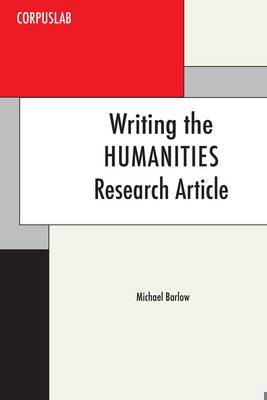
Writing the Humanities Research Article: A Corpus-Based Guide to Structure and Language is a practical writing guide for humanities scholars at every stage - from graduate students drafting their first article to experienced researchers refining their prose.
Unlike most academic writing guides, which draw on social science models, this book is built on a dedicated humanities corpus of approximately 450 peer-reviewed articles comprising nearly 2 million words. Because humanities papers rarely follow the standard IMRDC structure (Introduction, Methods, Results, Discussion, Conclusion), advice designed for social science writers often misses the mark. This book addresses that gap directly.
The book opens by mapping the distinctive macrostructure of humanities articles, identifying three organisational paths: the thematic paper (Introduction, thematic body sections, Conclusion), the hybrid paper (thematic sections followed by a Discussion), and the empirical paper (the familiar IMRDC model used in a minority of humanities research). Writers learn to identify which path suits their project and how to design effective thematic headings.
The book covers IMRDC structure, but concentrates on the Intro, Body, Conclusion structure and the moves associated with each part. It also discusses the language constructions most commonly used to accomplish these moves. Another important part of humanities papers is Notes, and we dedicate a unit to a discussion of the conventions assocaited with this component of the paper.
Rather than prescribing templates, the book shows what published humanities writers actually do, sentence by sentence. Beyond individual sections, dedicated units trace the patterns that span an entire paper: how tense shifts across sections, how citation density rises and falls to mark the argumentative arc, and how hedging and boosting interact to control the strength of claims from Introduction through Conclusion. A unit on structuring the thematic paper - the dominant form in the humanities - provides specific guidance unavailable in standard writing guides.
The approach throughout is practical and writer-centred. Every pattern and example comes directly from the corpus. The book encourages a three-stage process: conceptualise first (deciding what you want to say), then consult the corpus evidence to find constructions that fit your purpose, and finally compose in your own voice. The corpus provides a repertoire of options; your argument determines which options to choose.
Spécifications
Parties prenantes
- Auteur(s) :
- Editeur:
Contenu
- Nombre de pages :
- 108
- Langue:
- Anglais
Caractéristiques
- EAN:
- 9780940753396
- Date de parution :
- 18-02-26
- Format:
- Livre broché
- Format numérique:
- Trade paperback (VS)
- Dimensions :
- 152 mm x 229 mm
- Poids :
- 204 g


Seulement chez Librairie Club
+ 52 points sur votre carte client de Librairie Club
Cadeau


Les avis
Nous publions uniquement les avis qui respectent les conditions requises. Consultez nos conditions pour les avis.