


- Retrait en 2 heures
- Assortiment impressionnant
- Paiement sécurisé
- Toujours un magasin près de chez vous
- Retrait en 2 heures
- Assortiment impressionnant
- Paiement sécurisé
- Toujours un magasin près de chez vous



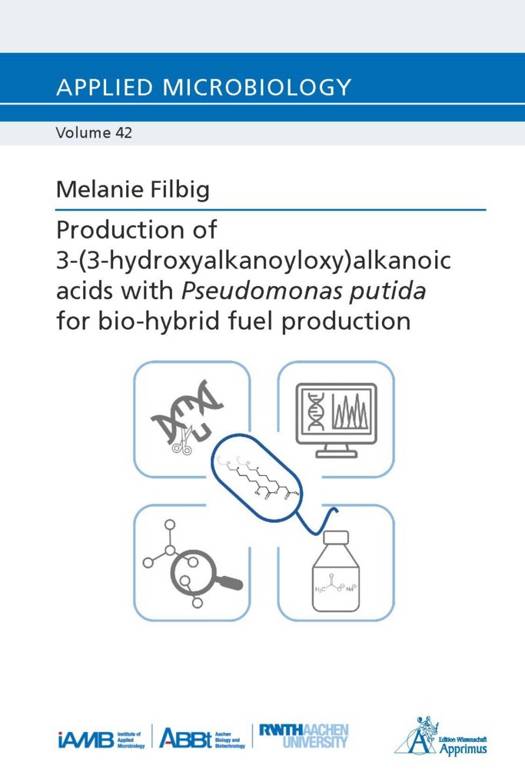
Production of 3-(3-hydroxyalkanoyloxy)alkanoic acids with Pseudomonas putida for bio-hybrid fuel production
DE
Melanie Filbig
53,45 €
+ 106 points
Description
Rhamnolipids are biosurfactants with diverse applications. Their precursor molecules, 3-(3-hydroxyalkanoyloxy)alkanoic acids (HAAs), also exhibit promising surfactant properties and can serve as intermediates for the chemical production of bio-hybrid fuels with diesel-like characteristics. This thesis aimed to use the non-pathogenic bacterium Pseudomonas putida KT2440 for the recombinant production of rhamnolipids and HAAs. Several strategies were pursued to improve production and to enhance the understanding of the underlying metabolic pathways, thereby contributing to a sustainable bioeconomy.To improve biosynthesis, a novel heterologous gene expression strategy was investigated. Since P. putida naturally produces structurally related polyhydroxyalkanoates (PHAs) under nutrient limitation, rhamnolipid biosynthesis genes were integrated into the PHA locus and expressed under nitrogen starvation. Expression of msfGFP was analyzed as a reporter. However, no rhamnolipid production was detected at this locus, and msfGFP expression remained low compared to established systems. Gene expression analysis indicated poor transcriptional activity, suggesting limited understanding of regulatory mechanisms controlling PHA-associated gene expression in P. putida KT2440.As the metabolic pathway for HAA and rhamnolipid biosynthesis in P. putida remains incompletely resolved, this study aimed to clarify key aspects of the biosynthetic pathway. To this end, knockout mutants deficient in central carbon and PHA metabolism were generated. Transcriptome sequencing and isotope labeling experiments with 13C-labeled substrates were also performed to evaluate the contributions of fatty acid synthesis and beta-oxidation. The combined results indicate that rhamnolipids are mainly synthesized from precursors originating from fatty acid de novo synthesis.Furthermore, acetate, a potentially CO2-derived substrate, was evaluated as a carbon source for biosurfactant production with P. putida to improve the carbon efficiency of the process. Since P. putida can utilize acetate natively and produce both HAAs and rhamnolipids from it, strain performance on acetate was improved using rational engineering and adaptive laboratory evolution.Overall, this work demonstrates that recombinant HAA and rhamnolipid biosynthesis still offers significant potential for optimization and highlights the importance of a detailed understanding of the underlying metabolism for targeted strain improvement.
Spécifications
Parties prenantes
- Auteur(s) :
- Editeur:
Contenu
- Langue:
- Anglais
- Collection :
- Tome:
- n° 42
Caractéristiques
- EAN:
- 9783985553365
- Format:
- Livre broché
- Dimensions :
- 148 mm x 13 mm
- Poids :
- 408 g


Seulement chez Librairie Club
+ 106 points sur votre carte client de Librairie Club
Cadeau


Les avis
Nous publions uniquement les avis qui respectent les conditions requises. Consultez nos conditions pour les avis.